

Learn why a semantic operations layer gives AI the context it needs to deliver accurate, trustworthy, and scalable results.
Think about how long it takes a new employee to understand how your organization really works. They eventually learn the relationships between products, business domains, teams, customers, and internal processes, but only through experience. Now imagine AI as your newest employee. Unlike people, AI can’t fill in the gaps through conversations, experience, or intuition, and the mistakes are more costly.
Organizations have invested in systems that store, manage, and move information. Those systems do not share a consistent understanding of what the information means.
This lack of understanding has historically been a problem for humans and a big productivity cost to the organization. However, humans can compensate through experience, conversations, and inference. AI cannot.
AI needs a decoder ring to connect the information together.
A semantic operations layer provides the decoder ring by creating a shared understanding of common concepts, classifications, relationships, and business rules. It helps employees find the right knowledge, enables systems to exchange information accurately, and gives AI the context it needs to produce trustworthy answers.
The semantic operations layer is a foundational infrastructure for scaling automation and AI without scaling confusion and risk.
You need to make organizational meaning reusable and executable across content, data, workflows, and AI.
What Is a Semantic Operations Layer?
Terminology, taxonomy, ontology, and knowledge graphs work together as complementary components of a semantic operations layer. Together, these components create a shared, machine-understandable representation of how an organization’s concepts relate to one another. They also help the system apply the right rules to help govern content, data, search, and AI.
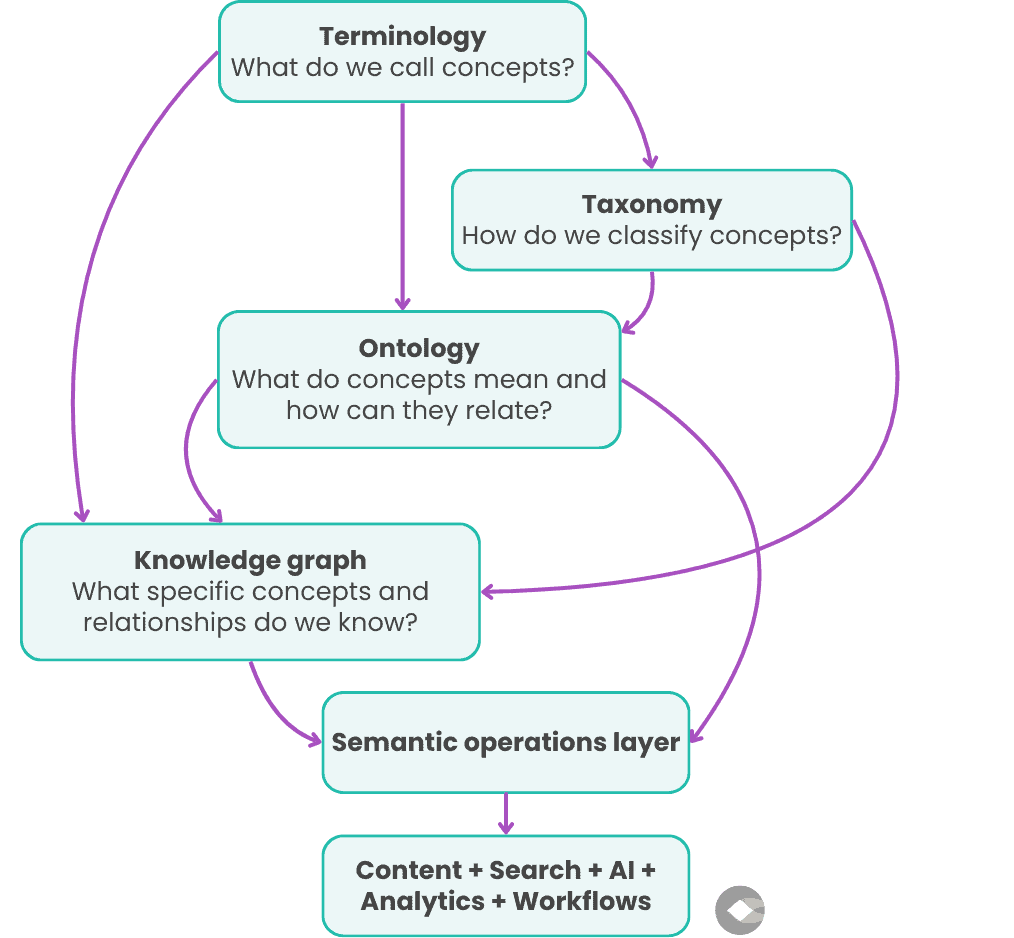
The role of each component in the semantic operations layer
| Component | Primary question | What it provides | Example |
| Terminology | What do we call something? | Preferred terms, definitions, synonyms, abbreviations, prohibited terms, and translations | “Infusion pump” is preferred; “IV pump” is an accepted synonym |
| Taxonomy | How do we organize and classify something? | Categories, hierarchies, facets, and metadata values | Medical devices → Drug-delivery devices → Infusion pumps |
| Ontology | What does something mean, and how may something relate to other concepts? | Concept types, relationship types, constraints, and logical rules | An infusion pump administers a therapy, has a manufacturer, and is governed by regulations |
| Knowledge graph | What specific entities and relationships exist? | A network of real products, documents, people, requirements, markets, and events | Product X is an infusion pump, has software version 4.2, and is supported by Manual Y |
The distinction between an ontology and a knowledge graph is especially important:
- The ontology defines the types of concepts and relationships in the semantic model, such as “product” and “owner”
- The knowledge graph contains the organization’s instances and facts, such as “infusion pump” (product) and “director of infusion device department” (owner)
How the Semantic Operations Layer Works
Consider the user question: “Which approved instructions apply to this pump in the European market?”
The semantic operations layer can interpret and answer this question because:
- Terminology recognizes that “pump” may refer to the preferred concept infusion pump.
- Taxonomy classifies the product, content type, market, and regulatory domain.
- Ontology defines relationships such as:
- product has model
- document applies to product
- document approved for market
- document has effective date
- version supersedes version
- Knowledge graph connects the particular pump to its exact model, approved document version, European market, and applicable regulatory requirements.
These components become a semantic operations layer when they move beyond reference materials and begin to actively control system behavior.
For example, a rule might state:
If content describes a Class II medical device and is intended for the EU market, then associate the content with the applicable EU requirements and require regulatory approval before publication.
Here, terminology identifies the concepts, taxonomy supplies classifications, ontology expresses the rule, and the knowledge graph provides the specific product, content, and regulatory facts needed to execute it.
What Makes Up a Semantic Operations Layer
A mature semantic operations layer generally contains:
- Managed terminology that contains terms, definitions, and identifiers
- Governed taxonomies for classification and navigation
- An ontology that defines entity types, relationships, and constraints
- A knowledge graph that connects organizational facts
- Governance processes for ownership, approval, versioning, and change management
The critical idea is that these components of the operational semantic layer are not separate documentation exercises. Together they create a reusable semantic foundation between organizational knowledge and the systems that act on it.
Terminology stabilizes language. Taxonomy organizes concepts. Ontology formalizes meaning. Knowledge graphs connect meaning to real-world information. The semantic operations layer makes them all operational.
Building Your Semantic Operations Layer
The good news is, your organization very likely already has at least one of these components in place. We can be your guide. Here are some quick tips to get started!
1. Choose one high-value business use case
Select a specific problem where inconsistent meaning creates measurable cost or risk—such as unreliable AI answers, difficult product-support searches, content duplication, or slow regulatory impact analysis. Define a few baseline measures, such as search time, answer accuracy, rework, or review effort.
2. Create a minimum viable semantic model
For that use case, document the essential:
- Business concepts and preferred terms
- Synonyms and conflicting definitions
- Categories and metadata
- Relationships among products, content, customers, policies, and requirements
- Rules for authority, applicability, version, and approval
Focus on the meaning needed to solve the selected problem, not a comprehensive enterprise ontology.
3. Test it in an operational workflow
Apply the model to a limited collection of content and data, then connect it to a real search, AI, content-management, or impact-analysis workflow. Measure the result, capture gaps, and establish owners who can govern and expand the semantic assets.
The guiding principle is: start with one business problem, build only the semantics required to address it, and prove the value in a working process.
Start with one business problem, build the semantics needed to solve it, and prove the value. When you’re ready to take the next step, Content Rules can help you build a semantic foundation that scales across content, data, and AI.