
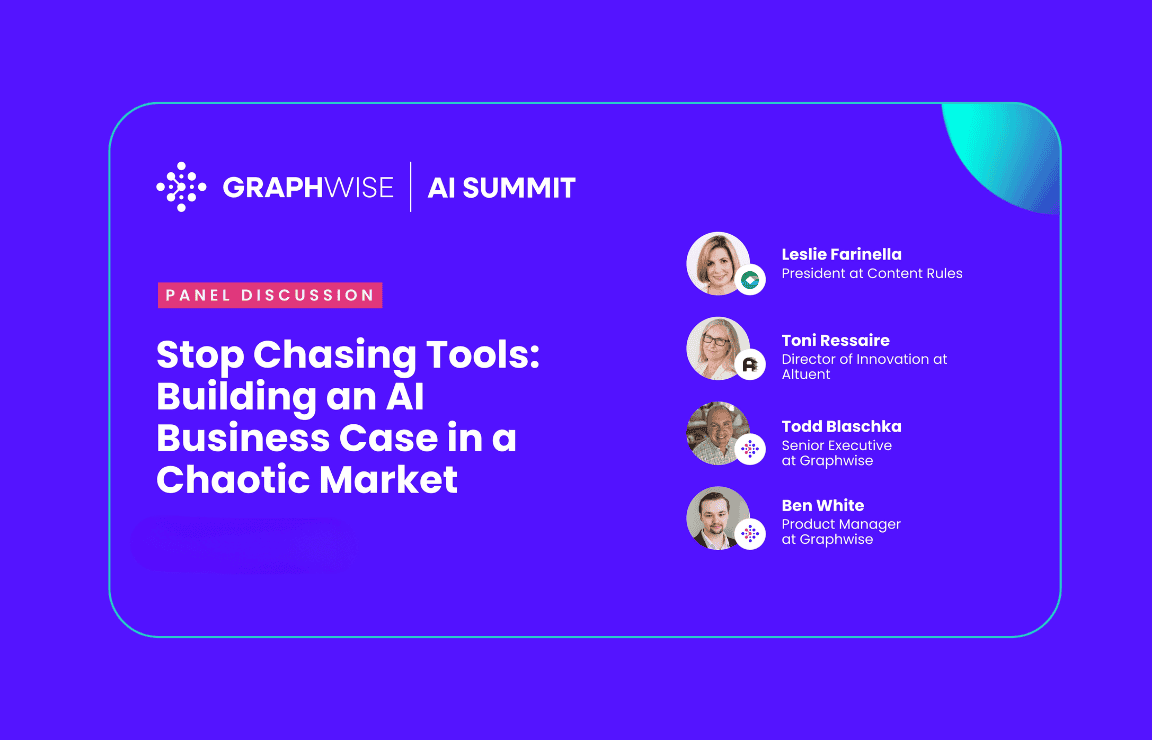

Watch the Graphwise AI Summit panel on-demand and discover how to build an AI business case that delivers value beyond a single use case.
The AI market isn’t slowing down. New tools, capabilities, and promises emerge almost daily, creating pressure for organizations to invest before they’ve clearly defined the business problem they’re trying to solve.
But adopting more AI technology doesn’t necessarily lead to better business outcomes.
At the Graphwise AI Summit 2026, industry experts came together for the panel discussion, Stop Chasing Tools: Building an AI Business Case in a Chaotic Market, to explore how organizations can make smarter AI investment decisions. One important takeaway:
The value of an AI investment shouldn’t be measured solely by the success of an individual use case. It should also be measured by the capabilities an organization builds along the way.
Start with the Business Problem, Not the Technology
A strong AI business case begins by identifying a specific business problem and understanding its impact that will withstand the test of time and evolving AI capabilities.
Tie your business case to business strategy and objectives:
- Revenue and adoption: faster onboarding, successful implementation, better API or developer experience, and fewer barriers to product use
- Service efficiency: better self-service, lower avoidable case volume, faster resolution, and less expert interruption
- Product release timelines: adoption of new features, reduced service calls
- Risk and compliance: accuracy, traceability, accessibility, version control, and evidence of review
- AI effectiveness: higher grounded-answer quality, fewer unsupported responses, and AI summary authority
Select a specific use case and map the value stream.
- Where are the bottlenecks?
- What’s preventing teams from working efficiently?
- Where could better access to trusted information improve outcomes?
Rather than launching a large-scale AI initiative, organizations can start with a focused use case, establish measurable objectives, and demonstrate value before expanding.
This approach helps reduce risk while creating opportunities to learn what works, what doesn’t, and what needs to change.
Think Beyond the Technology
AI technology will continue to evolve. Don’t make the business case or communication about the technology – highlight the business value.
That’s why an AI business case should consider more than the capabilities of a particular platform.
- Start with the business outcomes, even if they are a few steps removed from your span of control.
- Frame your strategy and the supporting initiatives as a portfolio of business capabilities, not a collection of tools, headcount requests, and disconnected projects.
- Share how you will measure success.
Don’t forget that success involves teaching people new skills and updating processes, as well as technology. Investments in content quality, structure, governance, and organizational processes create a foundation that can adapt as technology changes.
Focusing on the business outcomes gives organizations greater flexibility to evaluate new solutions, expand into additional use cases, and respond to changing business priorities without rebuilding everything from scratch.
The goal isn’t simply to implement AI. It’s to develop the capabilities needed to use AI effectively, now and in the future.
Measure the Value of What You’re Building
Traditional AI business cases often focus on immediate outcomes, such as time savings, productivity improvements, or reduced operational costs.
Those measures matter, but they don’t tell the entire story.
Organizations should also evaluate whether their investments are strengthening the capabilities required for long-term success.
Consider questions such as:
- Can the content and knowledge prepared for one use case support others?
- Are content quality, findability, and consistency improving?
- Can new AI applications be implemented more efficiently?
- Are governance and content management processes becoming more scalable?
- Can the organization adapt to new technologies without starting over?
Measuring both immediate business outcomes and long-term capabilities provides a more complete picture of AI investment value.
It also helps leaders make better decisions about where to invest next.
Watch the Graphwise AI Summit Panel On-Demand
How can organizations move beyond chasing the latest AI tools and start building a business case that delivers sustainable value?
Watch the Graphwise AI Summit 2026 panel, Stop Chasing Tools: Building an AI Business Case in a Chaotic Market, featuring:
- Leslie Farinella, President, Content Rules
- Toni Ressaire, Altuent
- Ben White, Graphwise
- Todd Blaschka, Graphwise
The discussion explores the challenges of evaluating AI investments, connecting technology decisions to business outcomes, and building the capabilities organizations need to scale.
Planning Your Next AI Investment?
Before investing in more AI technology, consider whether your organization has the content foundation and capabilities needed to support it.
Visit our AI Budget Planning Center for practical resources to help evaluate content readiness, prioritize investments, and build a stronger business case for AI.