Content Rules, Inc.

Source terms are usually stored in a database of some sort. This database could be rudimentary, such as Excel, or sophisticated, such as the Acrolinx terminology manager. Terms are usually single words or very short phrases.
Download this ebook on content optimization and learn what it takes to streamline your content like never before! In this eBook, we demystify content optimization and show you how you can make your content.
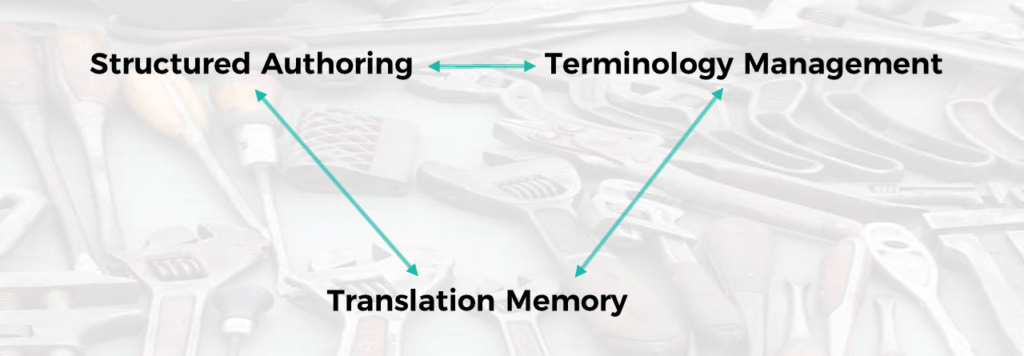
Have you ever heard the saying, “The whole is greater than the sum of its parts”? That’s the secret behind what I’ve termed The Holy Trifecta of global content. The Holy Trifecta is made up of three parts:
Recently, I was asked to help make a case for why terminology and consistency matter in a user interface (UI). Frankly, I was surprised that a case needed to be made. After all, doesn’t everyone understand the importance of a clear and consistent UI? Apparently not. Here are a few
People often ask me if optimizing their content is worth the expense (both time and money). My answer is, unequivocally, “yes”. Sometimes, the reason is quantifiable in dollars. You can add up the savings with an abacus or a calculator. Sometimes, the reason is more esoteric. After all, how do

One of the first and most important questions I ask any customer who cares about content quality is, “Do you have a terminology list?” About 70% of the time, the answer is, “Yes, we have a glossary.” Though they both have their uses, glossary and terminology are not the same
These days, everyone is trying to sell you on the “next big thing” for improving content quality. From XML authoring tools, to new CCMS systems, to quality checklists and quality checkers, there is no shortage of tools on the market.
I get a great feeling of satisfaction when all of my laundry is done. The clothes are washed, pressed, folded, and put away. Of course, things are put away in my uber-organized, structured closet. It’s that feeling of being done with a task – sometimes a daunting task if I
There is a close-knit relationship between terminology and structure. So close, in fact, that many people completely overlook it. I’ve tried to explain this many times and, for some reason, I don’t think I have been able to make the point as clearly as it needs to be. So, in
A few months ago, we had an interesting discussion about structured content being like your closet. A few additional people wrote blog posts on the topic, too. One thing we all agreed on (I think?) is that structure provides a way for you to organize your content.